Tuesday, December 4, 2012

Meat Mountain

I had been dating my husband for a couple of weeks and it was time for his initiation ritual.  He had already read "The Chosen" by Chaim Potok,  had tasted chopped liver on rye, had met both my Jewish grandmothers.  Together we watched "Fiddler on the Roof" and although he didn't enjoy it (too sentimental) he had agreed that the music was catchy.  Although he refused to watch Barbara Striesand in "Yentl," The next logical destination was Carnegie Deli for dinner. 

On a Saturday night, before going to a movie, we appeared at the door. I felt a nervous sensation.  What if there wasn't a table, what if the wait was too long and we missed our movie, what if he hates the food, what IF?  To distract myself I followed the revolving trays of cheese cakes in the dessert case. They didn't look real and perishable.  Where they made out of plastic or foam?  
The waiter who handed us our menus did not look like a twenty something very attractive gal or guy who had come to NYC to audition for theater.  He looked like a seasoned waiter with a look of resignation.  A professional waiter. His hair was slicked back and his white buttoned down shirt was spotless.
We were seated at a narrow table next to the wall and a man and a woman, probably in their sixties, sat next to us.  When the waiter came with a menu, she waved it away.  "We'll have two orders of roast chicken, well-done, and two egg creams."
They had a playful dynamic as if they too were out on a date.  We struck up a conversation with them and learned they had moved back into the city from the suburbs when they both retired.  "We love the city now that we don't have to work!"
"I'm a retired teacher and my husband is a dentist. Our children live in Westchester."
I loved this image...a devoted couple, their children all grown up, out together because they still had a lot to talk about.  Very sweet.
When the waiter brought their plates of food, the mood of the evening darkened all at once.
"Take this back to the kitchen.  Tell them Mrs. Lipman is here. Mr. and Mrs. Lipman.  I want it burned! Burned!"  Although when she said "Burned!" it sounded like "Boy-nd!"
This soft spoken woman had morphed into a demonic harpie proclaiming "I said BURNED!!!"
Her husband's face mirrored hers.  They were mad and that chicken had better be back on grill or else things could get violent in the dining room.
Surely I could relate to their preference.  I too had been a fan of well done hamburgers and steaks since I was a kid. However, well done is not the same as burned.  Well done and burned were on different levels of flavor.  

The waiter did not look annoyed or perplexed.  He had the look of recognition so many waiters in NYC have when they have seen it all.  "Another pair of freaks" is what he was probably thinking.  He picked up their plates and returned to the kitchen.  They were tough customers but this was NYC so he had seen it all.  At least they didn't take their clothes off. 

Meanwhile, our pastrami sandwich had appeared and it looked like one pound of juicy meat.  It was difficult to imagine the two of us finishing it. The dill pickle on the side was crunchy and tart.  The combined salt content between the two was enough to encourage both of us to drink enough water for a family of ten.

As we chewed our sandwich (three dollar charge for sharing) we were both eavesdropping on the Lipmans.  It seemed they had spun an invisible shield of tension around them.  I found myself earnestly hoping that the cook was burning their chicken beyond recognition so that they would relax again.

The waiter reappeared with two charred pieces of meat.  They may have been chicken at one time but now they look like large burned coals.  I wasn't sure what would happen.

Mrs. Lipman's face relaxed. "This is just how we like it!"  and she morphed back into a petite lady in a pastel cardigan.  Her husband looked like a kindly dentist again too and they smiled at us.
"They know us in the kitchen," she explained.

Carnegie Deli
854 7th Ave.
New York, NY

Monday, May 14, 2012

Matzo Balls

    This is a story about soup.  Matzo ball soup.  My grandmother, Nan, made the best matzo ball soup.  I was an awkward sixth grader with a crush on the popular boy in class when my grandmother offered to teach me how to prepare my favorite soup.
    "I'll teach you how to make floaters, not sinkers," she assured me. The key to a successful matzo ball was its density, and Nan knew how to create a light, fluffy ball.  She wanted to pass on the secret to me.  I needed something to cheer me up, something like a secret recipe.  Maybe she thought it would make me feel special if I knew how to make it myself.  The social order in sixth grade was changing.  New alliances were forming and it worried me.  I'm talking about my friend, Lizzy Richman.
    Over the summer she must have grown five inches taller and curvy.  She towered over most of us.  I noticed her slouching her shoulders and wearing loose shirts.  Despite her efforts at modesty, she had some new admirers: all the boys in the class.
   Eliot Friedman noticed and chose her to be on his team when we played dodgeball at recess.  She was his third choice after Russell and Stephen, his best buddies, so we all knew Lizzy's standing had changed.
    Of course it could have been her height, which can be an advantage in dodgeball.  Lizzy was a giraffe compared to the boys.  Whether it has her cleavage or her height, Eliot was paying attention to Lizzy.
    Then came the day that I stood in front of the pack during dodgeball and it was Eliot's turn to throw.  The ball sailed directly into my face, as if it had radar.  The blood leaked out of my nose and stained my t shirt. Eliot ran over to me and looked concerned.  Not just concerned, but actually worried. About me.  Eliot Friedman was worried about me.
   An aide brought me to the nurse's office.  She phoned my mom and I lay on the bed and thought about Eliot with tissues stuffed up my nostrils.
    I went home early, my nose stopped bleeding, and I practiced what I would say to Eliot in the morning.
    It could have been otherwise, but the next day at school, I didn't exist for Eliot Friedman.  Lizzy, however, was third pick for his team.
    In the larger scope of life, kids get tossed around, embarrassed and, sometimes, humiliated.  Noses bleed.  Feelings get hurt.  Soup can help.  Knowing how to make soup by yourself can really do wonders.
  Although she meant well, my mother's soup was a salty, watery mess.  She tried but she didn't understand matzo ball density. Also, she didn't make homemade broth but relied on a can of College Inn chicken broth.
  Nan knew how to make soup.  She made the broth from scratch and her soups tasted like they had  simmered for hours.  They did in fact simmer for hours.  Nan's soups comforted upset stomachs, colds, fevers and even melancholy moods. Disappointment too.
   Nan taught me how to make matzo ball soup. For this I am grateful.  Did it solve all my problems at school?  No, but it balanced out some of the disappointment.
   Nan even explained the part that really counted in the endless debate about matzo balls: heavy or light?   Another way to phrase this is: floaters or sinkers?  The secret was so simple I wanted to laugh.  Nan looked like she was revealing a great mystery when she told me: "You have to boil the matzo balls in a large pot of water with the lid on. Thirty minutes, minimum. That is it. No more and no less.  Then you add them to the chicken broth."
   Who cares?  There is something that elevates a soup when a matzo ball is fluffy and light. It makes you feel better when you drink it.  A soup can just be a soup or it can have healing powers.


Matzo Ball Soup

5 Cups homemade chicken broth
4 carrots, thinly sliced.
2 stalks celery, thinly sliced.

matzo balls
2 T vegetable oil
2 eggs, beaten
1/2 C matzo meal
1/4 teaspoon salt
1/4 teaspoon pepper
3 T chicken broth
chopped parsley for garnish.

In a bowl, whisk the oil and eggs.
Combine the matzo meal, salt and pepper with the egg mixture.
Add 3 tablespoons of chicken broth and mix.
Cover and refrigerate for 15 minutes.
Boil large pot of water.
Form the matzo dough into balls about 1 inch wide and drop them into the boiling water.
Simmer, covered, for 30 minutes.
In another pot, heat the chicken broth to medium heat and add the carrot and celery.
Serve with chicken broth and chopped parsley.

Sunday, February 26, 2012

Bagel Run

   On many a Sunday morning my grandmother, Nan, knocked on our bedroom door and announced, "Get up! Time for a bagel run!"
A bagel run did not involve physical exertion but was a ritual of going to the bagel store in the morning after a sleepover at her house. It also involved buying smoked salmon, a newspaper and candy, but the bagels were most important.
   Nan looked like she had been awake for hours.  In fact, I have no memory of every seeing her or my grandfather in their bed.  Strange that their bedspread was always perfectly smooth.  There was no time to sleep, unless you were a kid and then you had better be in bed early.
   She hovered around us, making sure we dressed quickly so we could leave.  My grandfather, however, was calm and somewhat oblivious to the mounting tension.  He didn't want to rush us along and in this way he was a counter balance to Nan.
    After hustling us downstairs,  Nan tossed our jackets at us and pushed me out the door while Red Dog, her Irish Setter, jumped around like a pogo stick.  We could never leave the house fast enough for Nan.
"Hurry up Louie...they need to eat breakfast today, not tomorrow," she said.
  Our first stop was Tabatchnik's Appetizing, a small shop where you could buy smoked fish, chopped liver, herring, pickles and cream cheese.
"I'll have a pound of Nova." said Grandpa.  He meant cold smoked salmon.
"The usual," echoed Marty, who always sliced the fish for us.  I liked him because he gave me and my brother little pieces to taste.  Marty sliced the pink flesh with precision into slices that were as thin as tracing paper.  Mesmerized,  I could have stayed for hours.
   Next door was the newspaper shop owned by an elderly German couple, the Finkelsteins, who were eager to talk about politics with my grandfather. While they talked about Watergate and Nixon, my brother and I discussed the candy selection.  We were allowed one piece each and took our time. I either went with a package of red licorice, a box of Sugar Babies or a Charleston Chew.  You would think we had never seen candy before. 
   By the time we arrived at the bagel shop, the line was out the door.  It was time to focus and decide exactly what combination of bagels we wished to buy.  We knew we wanted a dozen, which came with one free bagel.
"How about three sesame, four onion, two salt, four cinnamon raisin?" suggested Grandpa.
 "I like pumpernickel," I said.
"O.K. Three sesame, three onion, two salt, three cinnamon raisin and two pumpernickel?"
"I want a plain bagel," said Lee.
My grandfather was patient and seemingly unaware of time, yet he knew the unspoken rules of the bagel store.  When it was our turn my grandfather ordered for us.   No one in Great Neck said "please" at the bagel store.  No one said "Thank you."  If you forgot this decorum people might think you were from the Midwest.  You said what you wanted and you moved to the side so the next person could order.  Period.
   My grandfather said, "I'll have two sesame, two plain,  two onion, two pumpernickel, four cinnamon raisin."
The bagel man, who always looked annoyed, said, "You get one free." as if he hated saying it.  He could have been saying, "Please, shoot me in the head and take all my money."
You couldn't just order thirteen bagels.  You had to wait for him to say, "You get one free" and then you requested the additional bagel.
"Salt." said my grandfather.  Then he paid and got change.  No one said "Thank you" or "Have a nice day."
   My brother and I both wanted to carry the warm bag of bagels home.  We had to switch off each week but no one remembered who carried it last so sometimes we each carried it half the time in the car.
  Our total time since we left Nan's house was less than forty five minutes.  Nonetheless, Nan was agitated when we walked in the front door.
 "What took so long?" she said.  I don't think it mattered what time we arrived because her perception was always right and we were late.  Sunday morning was the same as every other morning in Nan's world: a rush for some reason.  There was always a reason and it could change at any time.  After all, she made the rules and invented the problems.
"Wash your hands! People are sick in this town!" she said.
    With clean hands we sat down at the table, each of us placing our candy in front of our plate for afterwards.  Red Dog positioned himself at my feet.  Nan had poured little blue glasses of orange juice for us.
"Drink your juice! You need liquids!"she said.
Nan expertly sliced our bagels in half and piled them high with a schmear of cream cheese and sliced Nova. Then she cut them in half to make it easier to handle.  Yes, she was thinking about efficiency and bagel handling.  Why?  Because we had to eat, even if we weren't hungry.  It didn't matter. We had to eat every morsel on our plates.  If for some reason I said I wasn't hungry, I got the same response.
"Not hungry?  Oh you have such problems.  During the Depression no one had enough for a sandwich, much less a cup of soup!  Your grandfather ate a bag of peanuts for lunch.  Your great-grandmother had to rent out rooms to put food on the table.  And you can't eat a bagel!"
   If this didn't shame me, one look at my grandfather did the trick.  I believed that if I didn't eat that bagel I was somehow responsible for their past suffering.  There is a name for this kind of persuasion from a Jewish grandmother.
 This is why I had a special relationship with Red Dog.  If I couldn't finish my food, he was ready under the table to help me out.  He chewed quietly.  This only happened some of the time because, like most kids, I loved a bagel and salmon. 
  Nan was a tough lady who didn't hear the word"no."  She lived in fear of what would become of me because I ate my mother's cooking.  Nan used to pick up my shirt, without asking, to examine my rib cage.  Then she would shake her head and mutter:
"Why doesn't she eat?" as if talking to no one in particular.  My brother, Lee, kept her satisfied because his chubby belly was a proclamation of health.  I was thin until I went to college and thus a constant concern to her.
   Looking back, I don't ever want to force feed anyone, especially the ones I love.  I still love bagels but in Bozeman they taste like bread.  This just isn't the place for a bagel run.  When I visit NYC I love to eat bagels.  New Yorkers always say that the bagels taste the way they do because of the water and I know it is true.


Monday, January 23, 2012

Primanti Bros.

Something happens to me when I am in Pittsburgh; I walk around craving food that is fatty, salty and smothered in cheese.  As soon as our plane lands at the airport, I start planning our visit around particular restaurants. The sandwich that most epitomizes this desire is the pastrami and cheese sandwich at Primanti Brothers in the Strip District.

It wasn't always like this for me.  Before I experienced Primanti Brothers,  my ideal sandwich architecture was modeled on a NY Deli pastrami sandwich.  The pastrami sandwich at Carnegie Deli is essentially a tower of pastrami (five inches high or more) enclosed by two pieces of rye bread, one of which is spread with mustard.  The simplicity of the construction is very different from a Primanti Brothers sandwich which has a variety of layers, one of which is french fries.  For me, that layer of slightly greasy fries takes this sandwich to a higher level of delicious.

I've come to Pittsburgh with my family to attend my mother-in-law's wedding.  Yes, there will be an elegant dinner, cocktail party, etc. but the four of us have a understanding that we must get to Primanti's ASAP.  Yes, I am the type of mother who makes organic peanut butter and jelly sandwiches for my kids.  Their lunches are whole grain, organic, low fat and hi fiber.  Primanti Brothers allows us forget all that.

Primanti Bros. is open 24 hours but this wasn't always the case.  It began as a sandwich cart in the 1930's and sold sandwiches to truckers on the go.  It opened at 3AM.  What began as a Depression era sandwich shop has evolved into a restaurant that feels like a historic diner, except that everyone comes for the same thing: the sandwiches.

My family and I arrive at 1PM for lunch and the place is jammed.  Seventies era wall murals of Pittsburgh luminaries like Mr. Rogers and Franco Harris provide the decoration.  The tables and chairs are no frills and don't encourage a person to sit for too long.  This is not a lingering place.  People fill up and go.

The four of us sit on stools at the counter in order to watch the action at the grill.  The cook could be my grandmother and she is smiling and chatting with customers.  You get served very quickly and it is fun to watch the orders move from grill to customer.  Even though we don't have long to wait, the anticipation is part of the fun.
The menu on the wall has so many choices that it is difficult to decide what to order.  However, for me the pastrami and cheese sandwich is the queen of all the sandwiches.  Let me describe the layers, starting at the base:

1.The fresh Italian bread is just fluffy enough to absorb the juices of the sandwich but does not get soggy.
2. The pastrami is lean and peppery and doesn't overwhelm the sandwich.
3. The melted cheese balances the brine of the slaw and the sharpness of the meat.
4. The fries are hand cut and a little bit greasy, nice and salty.
5. The coleslaw is sour and a little bit sweet. It's crisp texture plays off of the chewy bread.

These five elements all come together and create a sandwich that is balanced, succulent and unique;  so tall it begs to be squished in order to take a bite.  We also order a fried egg and cheese and it is almost as special as the pastrami and cheese, but not quite.

The four of us quietly savor our lunch,  knowing that these sandwiches are unavailable in Bozeman, Montana, where we live.   I feel grateful that I do not live here in Pittsburgh because I would have health problems from eating food like this all the time.  At any hour of the day or night, this sandwich is so delicious that it leaves you with a craving long after you leave Pittsburgh.

Primanti Brothers
46 18th Street
Pittsburgh, PA 15222

Friday, December 23, 2011

Raccoons

Raccoons are not cute.

When I was twelve, I used to lay in my bed at night and listen to the neighborhood raccoons dig through our trash and tip over the cans.  The clanging woke me up every time.  Sometimes I saw their sinister eyes glinting in the darkness and it didn't help when one of the posse bit off my cat's ear.  She looked permanently lopsided and she was never allowed outside at night again.

Fast forward thirty- two years.  I am living in Bozeman, Montana and I have taken a fancy to chickens.  I'm allergic to cats and Lollipop is just a memory with her orange fur and half-eaten ear.  The baby chicks for sale at Murdoch's have tempted me and Peter and Griffin start drawing up plans for a coop of our own.

We consult magazines and websites like Backyard Chicken, and for Griffin, Design Within Reach, while considering a plan. When Peter and Griffin design our chicken coop, they take the threat of predators into consideration.  It seems safe but to find out if a coop is safe it has to be tested.

Spring and summer are uneventful.  The hens waddle around happily going about their business.  Then on a morning in September the hens look spooked and I find a decapitated chicken in the corner of the run, against the fence.  It was Bronco, my friendliest chicken with her crooked feet.  A rancher had thrown her in for free after we bought five chickens from him.  Bronco layed lots of eggs and even some double yolks.  Bronco was a great hen.

I didn't see the problem and the next night I lost two more hens.  Then I saw that the back lock of the coop had been ripped off and was useless.  I wish I had known but now I was down to two hens and I didn't have the heart to keep them.  A neighbor of mine with a safer coop adopted them and we wrapped Pearl and Flo in old towels and drove them to their new home.

Many people who knew better told me not to name my hens.  "They are just farm animals," said the woman who sold me chicken feed. "You can't get attached to them," she added.

But I did grow attached to them.  They not only had names but distinct personalities and they were a source of entertainment.  Molly, one of the Buff Orpingtons, used to follow me around and try to come into the house at every opportunity.  If we left a window open she would sneak in and roost on the window sill,  She once marched in and roosted on the toilet.

It has been five months since I had chickens and frankly, I miss them.   I think I should give the chicken experiment another try.

Wednesday, November 30, 2011

Katz's Delicatessen

As I passed through the door the aroma of kosher deli meats tickled my nose--a sweet, peppery, smokey scent--and I felt an urgency to grab my punch card and hurry to the counter.  However primal, this feeling made me nervous as I stood at the counter behind which my favorite childhood food sizzled on a grill: a kosher hot dog.

We were visiting NYC, had just devoured a huge lunch at a Moroccan cafe but it didn't matter.  I was full but it didn't register.
"One hot dog with sauerkraut and mustard please."

In the brightly lit room, the walls plastered with 8x10 photos of celebrities, we managed to find an empty table.  I offered to let Griffin and Rachael sample the treat first but they declined.  Then I took a bite, savoring the crispy skin and the chewy meat inside.  What exactly the meat consisted of I didn't know except that it came from various parts of a cow.  It tasted exactly the way I remembered and I was transported back in time.

In middle school, Saturday mornings meant going to "town" where we walked up and down Middle Neck Road in groups of four or five girls with our allowance money in our pockets.  This being Great Neck, our allowances were generous enough to cover both lunch and a visit to the candy store.  Lunch usually meant Kensington Deli.

Dimly illuminated and dingy, the narrow room had booths on one side and a lunch counter on the other.  It smelled like sweaty kids and hot pastrami.  A lanky man with a permanent toothpick in his mouth tended to us.  He had unlimited patience and I wondered if any of us could make him crack.   "What do you want?" he said.

There were many choices: brisket, tongue, roast beef, turkey, chopped liver, tuna salad.  Perhaps the least interesting item was kosher franks. Every time we went through the same dialogue of indecision: "What are you having?  I don't know..what do you want?"
"I don't know."
"I don't know either. What are you ordering?"
After this routine, I always ended up with the same lunch: two hot dogs with sauerkraut and mustard and a Dr. Brown's Cream Soda.  Sometimes one of us splurged on a knish and cut it into fourths.  The pleasure from this meal was more than eating salty franks and drinking a sugary soda.  It was being a thirteen year old kid and giggling with girl friends who had mouths full of shiny braces, glittery lip gloss and pimply skin.  It was pom-pom socks and Tretorn sneakers.  It was serious questions: "Who is cuter; Jimmy Connors or Bjorn Borg?"
"Who has B.O.?"
"Who likes Corey Miller?"(class president)
"Who shaves their legs?"
"Have you heard that they found rat eggs in Bubble Yum?  It is so true!  I swear!"

Maybe this is why Griffin and Rachael let me taste the Katz's hot dog first, they could see me morphing into my thirteen year old self which either fascinated or frightened them. When Rachael finally took a bite, she looked disappointed. "It just tastes like a regular hot dog," she said.
Maybe she was right, but for me it was so much more.

Katz's Delicatessen
205 E. Houston St.
New York, New York

Kensington Kosher Deli
27 Middle Neck Road
Great Neck, NY

Friday, October 21, 2011

Hopper Hunting

When I was a kid I snacked on bagels.  Bagels covered with orange squares of American cheese melted in a toaster oven. Bagels with Pizza Quick sauce and a slice of rubbery mozzarella. (A bagel with a smear of cream cheese was breakfast)  Hummus and triangles of pita. I ate meat too.  Mini kosher hotdogs dipped in mustard.  I never considered insects.  I thought of insects as annoying (mosquitos) or obnoxious (green flies).
My childhood fell during the era of the mosquito zapper.  Warm weather brought the zappers out of storage and into suburban yards where they hung on the back porch.  Who could forget the zapping sound and the scent of burning insects.  No, I would not have considered eating insects.
Recently, my friend, Cooper, caused me to reconsider my preconceptions when he introduced me to one of his favorite snack foods: grasshoppers.
Cooper invited us over for Grasshopper hunting.  At age seven, he is an experienced insect hunter and excellent company.  When we came to his house, he explained that all you need is a bow and arrow (with a rubber tip) and a field with tall grasses.  He taught us to stalk the hoppers, shoot them and pull their heads off.
I couldn't help but observe that patience helps because it takes time to find the hoppers.  It took an hour and a half to catch a dozen.  


This snack food is ideally for a kid who owns a bow and possesses an adventurous palette, just like Cooper.  How do they taste?  According to my daughter, they taste like turkey.  To me they taste like shrimp flavored popcorn.

Fried Grasshoppers

2 dozen grasshoppers, heads removed
2 T canola oil
salt and pepper
juice from half a lime
ketchup for dipping

Heat the oil in a frying pan so that it is sizzling. Add the hoppers and fry them to that they are crispy, but not burned.

Remove the hoppers and blot the oil on a paper towel.
Put them in a bowl and sprinkle with salt and pepper to taste. Spritz lime juice on top. If you wish you can dip them in ketchup. Enjoy!

Thursday, October 6, 2011

Gristedes or Waldbaum's?

In my family, it was understood that the end result of the meal depended on where you bought the ingredients and whether you got a good deal.  At meal times, the conversation usually began with the origin of the protein that was being served. It went something like this:
Tasting the brisket she has prepared for dinner, my mother turns to my grandmother and says, "Mom, this brisket tastes like old shoe leather. It is inedible. Where the hell did you buy it?"
Nan appears unperturbed.  She calmly answers. "You asked me to get it at the new Gristedes in Little Neck. It was on sale."  From time to time, perhaps out of boredom, Nan occasionally ventured to grocery stores out of her way.
My mother does not give up.  She needs to assign blame to someone. "It is not fresh! They were trying to get rid of it so they marked it down." She grimaces, pushes her plate away.
"Joyce, how long did you cook it?"asks Nan, raising an eyebrow.  My brothers and I exchange knowing looks. It this is a dual between Nan and Mom, it is now over.
"That doesn't matter! I could have cooked it for two days and it would still be tough!"answers my Mom, defensively.
Nan backs down. "I always say, stick with Waldbaum's." That settled it. For the next few weeks, no one was going to get adventurous.

Consequently, I grew up in fear of brisket and mistrustful of Gristedes. It wasn't until I left home that it occurred to me that maybe the cook's technique or lack of may have had something to do with the food that was served at our table.

Fast forward twenty years and I am living in Bozeman, Montana. My children and I are sitting in our home school classroom on a Friday morning in September. Bow hunting season. My husband comes in wearing camouflage with blood splattered on his legs and arms and a look of contentment on his face.

If we were still residing in Los Angeles, I would be petrified. I would be dialing 911. However, we have been living in Bozeman for two years and there have been some changes in our lives.

We realize that he has shot an elk and dash outside to admire the carcass in the back of his pick up truck.  In the field, the elk weighed five hundred pounds on the hoof.  Peter quartered it and carried out each piece.  He has brought home the head as well, thinking there would be meat in the neck.  In Montana, you have to carry every edible part of the elk out of the field.  The elk's head is tremendous. Without thinking, I touch the soft fur between the elk's eyes and say:" Thanks for the meat."

I send a text message to a few friends, announcing our good fortune. Some of our neighbors come over. There is a lot of blood but no one is bothered.

My phone rings and it is a close friend. I know what question is coming. After congratulating me she asks "Is it a cow or a bull?

It is generally understood that the most tender and flavorful elk meat comes from a female, a cow. Before my friend can assess the complete value of our kill, we have to establish the question of the elk's gender.
"A cow."
"Wow, congratulations!"
Not only do we have an elk to eat all winter but it is a cow.  I've come a long way from my former Los Angeles food cravings: sushi, fish tacos, anything in mole sauce.  There is nothing I would rather eat than elk meat.  O.K., maybe whitetail deer.


One of my favorite ways to eat elk is in a ragu sauce over pasta.  This recipe works for venison too.

Elk Ragu

!/4 C extra virgin olive oil
1 pound ground elk
1 onion, finely chopped
1 carrot, finely chopped
1 celery stalk, finely chopped
6 garlic cloves, crushed
1 8 oz. can chopped tomatoes
4 T tomato paste
2 C red wine
2 cups chicken stock
1 T dried basil
salt and pepper to taste

1. In a heavy bottomed casserole pan, heat the olive oil over high heat and cook the ground elk meat.  When the meat is fully cooked, put it on a plate and set it aside.

2.In the same pan, add more olive oil and cook the onion, carrot, celery, basil and garlic over low heat, stirring frequently.  Add the tomato paste and the chopped tomatoes. After five minutes, add the wine and chicken stock.  Bring to a boil and return the meat to the pan.

3.Reduce heat to a simmer and cook, uncovered for one hour.  The sauce should reduce quite a bit.  Season with salt and pepper.

Serve over your favorite pasta!

Wednesday, August 31, 2011

First tomato


When I first moved to Montana, a neighbor mused:"Those tomato plants in your garden don't stand a chance."
I had no idea what she was talking about. I knew that a tomato needed healthy soil, lots of sunlight, water, and a pair of strong hands to yank out the weeds.

Turns out there were a few things I didn't know. I guess I didn't expect snow in June. In Bozeman, tomato plants are lucky if they make it into the ground by July first. I also didn't expect summer hail storms. Another neighbor reminded me to build a hail protector(an apparatus of plastic pipes and a tarp) over my garden which I could unfurl if and only if I happen to be at home when a hail storm strikes. If any tomatoes survive the snow and hail, there is still a chance they will be nibbled by deer who wander into everyone's yards after dark.

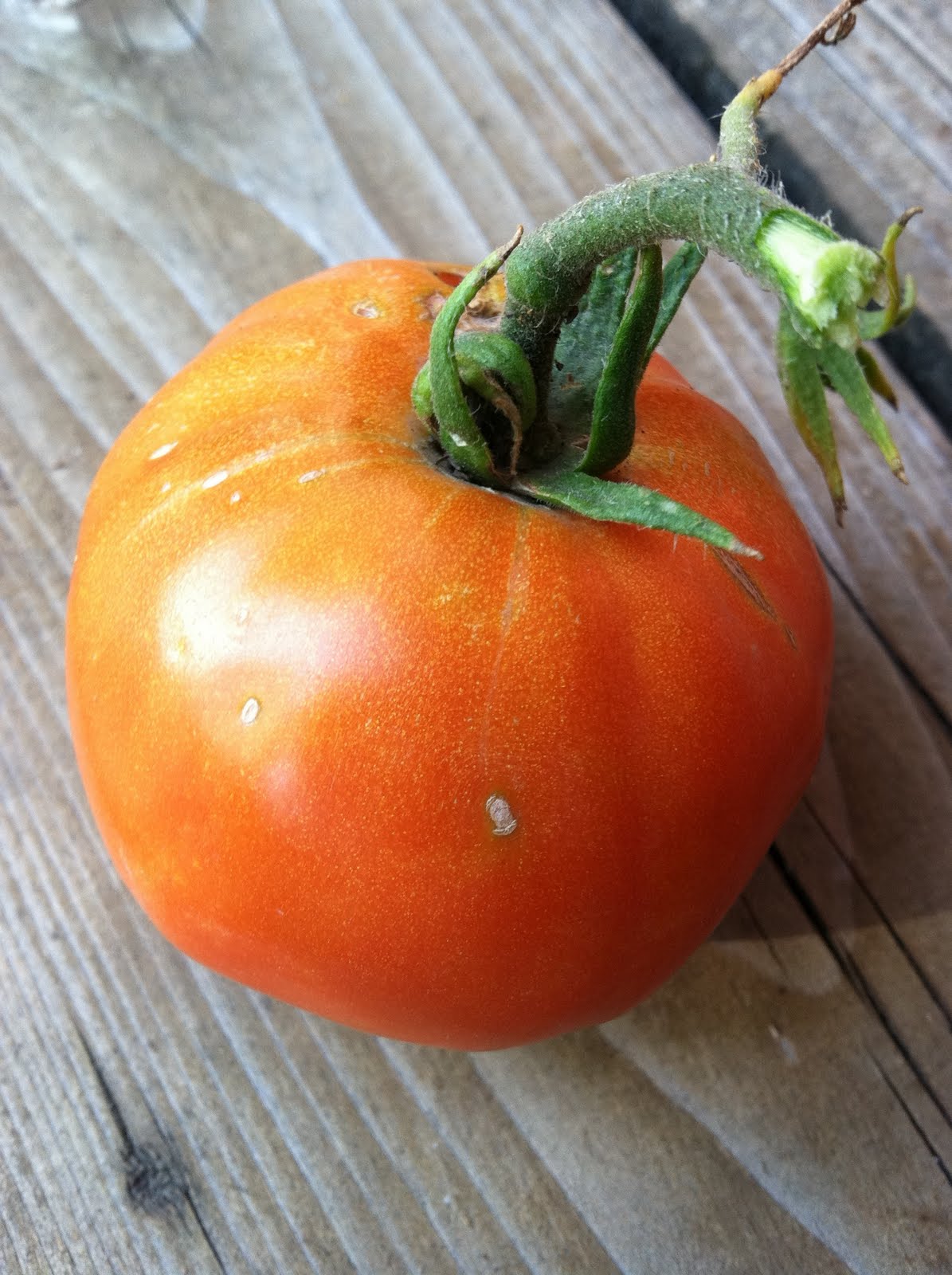
Given these challenges and my lack of experience as a gardener, the odds of a plentiful tomato harvest were low. Despite this, on August 31st, a single tomato in my garden ripened. When I picked it and sliced it into fourths for my family, it tasted sweet and juicy. It was as perfect as a tomato could be!

As for the rest of the green tomatoes, if they can survive the remainder of the summer, there is still time to ripen. Or else I will make fried green tomatoes.

If I had a whole bowl of tomatoes, I would cook this recipe for my family:

Baked Tomatoes, Goat cheese and Basil
4 rounds of goat cheese
1 1/2 cups of tomatoes, cut in half (any tomato will do but cherry tomatoes are best!)
1/2 cup olive oil
salt and pepper to taste
6 leaves of fresh basil
one large clove of garlic, crushed
Four slices of French bread

Preheat the oven to 400 F
Pour olive oil into a flat ovenproof dish and add the garlic. Put the tomatoes in the oil and then add the goat cheese on top. Add a few shakes of salt and pepper.
Bake for 10 minutes. When done, add slivers of basil.

Serve with toasted French bread.


Saturday, July 9, 2011

Close Call


Who wants to eat a live chicken? Apparently, many neighborhood predators. Why not? They strut around their chicken run, plump and potentially succulent..defenseless. Or so I thought...

It was a dark and stormy night, scratch that, it was a full moon and and a clear night. In fact, the moon resembled a great slice of cucumber. Perfect visibility for our neighborhood predators. Sometime after midnight, I was awakened by gawking and screeching sounds from our yard. Peter and I stumbled outside and tried to locate the creatures making those noises. Or what remained... I prepared myself to stay calm if I found pieces of chicken. After all, I knew this could happen. My brain had gone through the scenario many times, especially on nights with a full moon.

I was prepared to defend my hens. If I had a shot gun I would have carried it high in the air. A protective instinct coupled with an angry need for revenge pumped through my veins. As I looked for them, I pictured a huge raccoon carrying away a bloody chicken in her jaws.

With a pocket flashlight I scanned the yard and found three dazed hens in various poses. Molly and Gotterfunken, frantic and squawking and Pearl, glowing in the moonlight, while she sat in a daze, surrounded by an explosion of loose feathers. I could have stuffed five pillows with feathers. The other chickens were hidden in shrubs and trees. Everyone was alive and the only thing to do was to carry them back to their coop.

I would have carried them into the house and given them sleeping bags and mugs of warm tea. However, this wasn't an option. We tried to put them back in their coop one at a time but each time they fled. Who would run back into a burning house?

Three things I have learned about chickens:
1. They are smarter than you think
2. They remember more than you think they would
3. They can escape from the claws of an owl

There was nothing to do but try to go back to sleep. I lay awake for a long time, imagining a snake or rat or coyote or bear that was going to make a second attempt at a chicken dinner. I suspected that as soon as I fell asleep they would all be doomed. Peter was already snoring.

In the morning they were gathered around our basement window, hiding under a clump of daisies. They appeared to be waiting for breakfast but I wasn't playing that game. I wanted them to return to their own turf. I caught each hen and returned her to the coop. I failed. Each one just hopped out.

The chickens would not go near their coop. They wanted new real estate and they didn't need a broker in a shiny Cadillac.

The yard was theirs until I could find a solution. A condo? A penthouse apartment?
I needed time to think it through.

I cooked myself a bowl of oatmeal and brewed a mug of my favorite tea, Lady Grey. Not true. Actually, I asked Peter to cook me a bowl of oatmeal. Why? Because he doesn't measure ingredients, cooks by intuition, and it tastes creamy and delicious!


Peter's Comfort Oatmeal

1 cup rolled oats
2 cups boiling water
1 tablespoon brown sugar (or more if you wish)
1/4 teaspoon cinnamon
1 tablespoon chopped walnuts
1 tablespoon dried cranberries or cherries

Note:
Before you begin cooking, double the recipe because chickens absolutely love oatmeal.

In a medium sauce pot, bring two cups of water to a boil and add the oats. Reduce heat to a simmer and cook on low heat for about two minutes.

Pour the oatmeal into a serving bowl and add stir in the sugar, cinnamon, walnuts and cranberries. Enjoy!


Friday, May 6, 2011

Gotterfunken


When we pulled up to the ranch in Belgrade, the ranchers were sitting on their porch waiting for us. A young couple with their toddler, they wore denim jackets and plaid shirts. Tan and strong, they resembled actors in a Chevy Trucks commercial. They had advertised healthy adult hens for 25 dollars each on Craig's List. We only had one chicken left, Molly, and she seemed lonely and pathetic.

What happened? In early July the sky opened up and hail the size of baseballs bombarded our chickens. All ran for cover but Schnitzel didn't make it in time.

Our remaining chickens suffered an unfortunate mishap with a dog who I will not name to protect her privacy. To her defense, her size may have contributed to the end result. Resembling a woolly mammoth more than a dog, she may in fact have been "playing" and unintentionally killed four chickens in three minutes, forty seconds.

We had come to Belgrade to start again. This was our chance at redemption: five new adult hens.
The ranchers led us to their chicken house, a concrete bunker with a wall of nesting boxes. Dusty, pungent and dimly lit, it was loud as a frat party. My eyes had to adjust to the low light. I noticed a nervous energy among the fowl, especially the roosters. They sensed trouble. One of them rushed at the rancher, spurs in the air.
"There he goes again!" he laughed. "We made his friend into a stew last week."
"How was it?" I asked.
"It didn't taste too good." He answered. "But he learned a lesson."
Apparently, the ranchers had to show these birds who was boss from time to time.

With the aid of a net on a long pole the rancher darted around catching hens for us. We choose a Buff Orpington, a Leghorn, a Wyandotte and a White Crested Polish. The rancher offered us a Red Cup hen with crooked feet for free. We accepted.

We hadn't brought a cage to transport them so the rancher gave us an old cardboard box. All the chickens fit inside, except the Buff, who I named "Fanny." The ranchers exchanged a look when I offered to let Fanny ride home in my lap.

When we opened the box in our yard, the chickens stepped out looking a little dazed from the journey. The White Crested Polish sprinted out like she was on fire and ran into a wall. She really couldn't see because her feathers covered her eyes. Griffin named her Gotterfunken, which means "Spark of G-d" in German.

The rancher had called our attention to her plight. It seemed the roosters had been plucking out the feathers from her head. Behind her skull she had a bald spot. We weren't just adopting this bird, we were saving her from rooster abuse. This was a rescue.

That evening, the hens followed Molly up the steps into their warm coop. Even Gotterfunken eventually found the entrance. They hopped up on their roost and closed their eyes. I dreamed about fresh eggs sizzling in a frying pan.


Texas Eggs

My father used to cook Texas Eggs for breakfast. It is a fried egg with a hat.

1 piece of whole wheat bread
1 egg
butter
salt and pepper

Cut a hole in the center of the bread. Save the round piece of bread. Butter the bread on both sides. Put a 1/2 teaspoon of butter in a frying pan and turn the heat to medium. When the butter melts, put the bread in the pan along with the bread circle. Carefully crack the egg into the hole in the center of the bread. Cook a few minutes and then flip it over. When you put the bread and egg on a plate, place the circle of bread on top of the egg. Serve with a generous dash of salt and pepper.

Thursday, April 28, 2011

Molly

Growing up in Great Neck, I encountered chickens in a multitude of ways, never alive. They were wrapped in plastic at the grocery store, spinning on a rotisserie at Poultry Mart or baked and cut into pieces on our dinner table. Here in Montana, we raise chickens in our backyards.

This is not just any Buff Orpington chicken; this chicken is a survivor. She has survived lightning storms, sub zero weather, hail the size of baseballs, and two dog attacks. She has survived winter in Montana. Need I say more?

When Molly was purchased from Murdoch's, she came home with five other chicks in a box. I felt like I just gave birth, only I had more energy. There was no formula or diapers in the picture and they ate and drank from their feeder whenever they had the desire.

Some people shelter baby chicks in their house and although I wanted to keep them in the kitchen, Peter would not consider it. The garage was insulated so they would be fine. (We hoped).

We made a nest for the chicks in a basin filled with wood shavings. The February cold kept the chicks huddled together under their heat lamp. Three Buff Orpingtons and Three Jersey Giants seemed like safe breeds for our first experience with raising chickens. Or so it seemed.

I felt like Godzilla when I tried to pet the chicks. Five of them ran for safety in terror of me. Molly, however, was fearless. She came over to my hand and walked up my arm. Maybe she was hungry, maybe she was looking for her mother, but, for some reason, she always hopped into my hand. Molly and I had a bond.

What kind of bond? Mother/daughter? Teacher/disciple? Chef/dinner? None of these. Molly was becoming a pet chicken. So many people have pet chickens that they sell diapers for "house chickens." I didn't want this relationship. But it was developing, every day.

Montana is a place where people raise chickens for eggs and meat. Most people don't give their chickens names like "Stretchy" or "Smiley." There are reasons for not getting too attached to a farm animal. (Stretchy didn't make it past ten days)

In Montana, people harvest their hens after about two years when the layers become less productive. I learned this at my doctor's office from the phlebotomist as she was drawing my blood. She was getting ready to harvest her thirty chickens and looking forward to a new crop of chicks.

To harvest, or not to harvest? This was the question...


Chicken Snack

4 leaves of romaine lettuce
2 zucchini
2 apples
4 carrots
4 bananas

Chop up all the veggies and fruit into bite sized pieces. Toss lightly in a metal bowl and carry out to the chicken run. Serves four chickens.

Wednesday, April 13, 2011

The Shiksa


The first time I met David Levine's new wife, she served us paella that was rich with saffron and hot pepper. The pan glistened with black mussel shells and scarlet lobster tails. She poured sangria from a tall pitcher into the adult's glasses. The year was 1979 and most of my parents friends were divorced, separated or just plain miserable. Megan and her two sons had moved into David's new house. Tan and blond, she wore no make up and dressed in a loose peasant blouse and worn jeans. My mother glared.

As soon as we said goodnight and were in our car, she turned to my father and said,"David is going to regret marrying that divorcee. She is too young for him! And her kids seem slow; the older one must be retarded."

My father, who had clearly enjoyed the evening, pointed out that David was divorced too. I could see that Dad appreciated Megan Levine. He laughed with her and enjoyed her cooking. The only one who looked tense was my mom.

"I think the clams were spoiled. I feel sick." she added, clutching her stomach.

The second time we went to Megan Levine's house, David poured glasses of scotch for my parents and Megan invited me to help her in the kitchen. She handed me a serrated knife and I sliced a baguette as she told me stories about a summer she worked in a vineyard in Southern France. I tried to picture myself picking grapes with a basket on my arm.

"Can you check the recipe for me? How much olive oil?" she asked. No one in my world would ever consult a cookbook. Why would they try a new recipe? Why not eat the same food all the time?
"Sure," I said, eagerly opening the book.

For my thirteenth birthday, Megan surprised me at my house, to my mother's discomfort. I could hear the false greeting in her voice:"Great to see you! How are your sons?"
Megan gave me a hug and I unwrapped her gift. It was The Good Housekeeping Cookbook. The same one she used. My initiation had begun. I could become one of the women who use cookbooks.

I loved the bright color photos of Ham Steak Hawaiian, Cheese Fondue and Banana Cream Pie. All I had to do was follow the directions. What could be easier?

My first attempt was cheese souffle, the photo on the book's cover. Just the word "souffle" sounded dangerous and French. It looked like grown-up food.

In the back of the kitchen cabinet I found a souffle dish. I was on my way. While I was beating egg whites, my grandmother, Nan, barged into the kitchen.
"That is not how you whip eggs. All wrong. Let me show you," she demanded.
"This is how the cookbook says to do it," I answered, still holding the electric beater in my hand.
"Who knows better, your grandmother or a cook book?"she challenged me.
I pictured Megan Levine with her confident smile in her kitchen. I could hear Simon and Garfunkel on her radio. Megan gave me this cookbook for a reason.
"I'm just following the recipe," I said, shrugging. I should have winked at her but you couldn't wink at my grandmother. She smelled a traitor.
"You'll be sorry. It won't rise if you don't listen to me." she warned.
I held up the book as if it was a talisman. The choice had been made. I had chosen the way of the shiksa.

Classic Cheese Souffle
from The Good Housekeeping Illustrated Cookbook

1/4 C butter or margarine
1/4 C all purpose flour
1 teaspoon salt
1/8 teaspoon cayenne pepper
1 1/2 C milk
2 four oz. packages shredded cheddar cheese (2 Cups)
6 eggs, separated

1. In a 2 quart saucepan over medium heat, melt butter or margarine; stir in flour, salt and cayenne pepper until smooth.
2.Slowly stir in milk and cook, stirring constantly just until sauce is smooth and thickened.
3.Add cheese and heat, stirring, just until the cheese melts. Remove pan from the heat. Preheat oven to 325 F.
4. In a small bowl, beat egg yolks slightly. Beat in small amount of the hot sauce to prevent lumping when added to saucepan.
5.Slowly pour warm egg mixture into hot sauce in pan, stirring rapidly to prevent eggs lumping.
6.In large bowl with mixer at high speed, beat egg whites just until stiff peaks form. Lightly grease bottom of a 2 quart souffle dish.
7.With rubber spatula, gently fold cheese sauce into beaten egg whites.
8.Pour mixture gently into prepared dish. For "top hat" effect, with spoon, make a 1-inch deep circle in top of cheese mixture, 1 inch from side.
9.Bake souffle in center of oven for 1 hour or until puffy and golden brown. Serve immediately.


Saturday, January 8, 2011

Waldbaum's


For most shoppers a trip to the grocery store is an uneventful errand. In the larger scope of life it is painless. It can even be pleasant, as far as chores go. It certainly ranks above cleaning the bathroom.
Going to the grocery store can also be an opportunity to bump into friends, gossip, zone out. Not for me and my mother at Waldbaum's. This wasn't just about running an errand. This was a mission to get a low number in line at the delicatessen.

"Run!" she commanded before the car pulled into the parking space at Waldbaum's. "Get a number!" I sprung from the car and darted into the store across the slippery linoleum floor. Was it dangerous? Yes. I had to avoid huddles of women in bright lipstick exchanging gossip about their neighbors.

"Have you seen Ida's new Mercedes?"
"What was Bobbie thinking? It is fluorescent yellow!"
"Bobby told Saul he is sick of her car accidents. Now they will see her coming."
"Yeah, you can see Ida from five miles away!"
"You can see Ida from the space shuttle."

I had to choose a route. Some aisles were so jammed with carts that I couldn't pass through. I had to move fast so I chose the baking aisle, which was deserted. No one in this town would ever turn on their oven to bake. Maybe to reheat a frozen pound cake, but not to bake from a mix that read "Duncan Hines."

Prepared food was Great Neck's daily bread and the busiest part of the store was the Mecca of prepared food: the deli.
I saw my destination: the bright red machine that printed numbers for the line. Women swarmed around the machine, clutching their numbers in their fists. I plunged in and grabbed a number. 198. The deli man's nasal voice announced, "Number 122. Serving 122." I had time.
I decided to check in with my mother.

"198!" she exclaimed as she perused ten pound mounds of ground beef. "We'll be here all day!"
My mother was always in a rush for no apparent reason. No job, a full time house cleaner, gardeners, etc. but she had little time to spare. I suppose she had places to go that were more pressing than Waldbaum's.
I felt defensive about my high number for the deli line. I should have knocked someone down to get a better number.
"You don't know that for sure." I said. "The line could move fast."
What a liar! I knew the line never moved fast. Why? Because of the sacred ritual of samples.
"I'll have two pounds of tongue," said a lady with orange hair. The deli man opened the case, extracted a log of tongue, lay it on the slicer and sliced off one piece which he offered to the lady.
"O.K.?" he said.
"Fine." she replied after chewing her sample.
As he commenced his work on the log of tongue I wondered why she needed to taste it. Does tongue vary in flavor from week to week? Did the meat processor in New Jersey change the preservatives and spices in the tongue? Anything is possible.
Everyone who orders cold cuts engages in this ritual. Everyone except me.
When my number was called I spoke quickly."I'll have two pounds of pastrami, two pounds of smoked turkey, two pounds of roast beef, one pound of potato salad, one pound of cole slaw and half a pound of scallion cream cheese."
"Anything else?"
"Half a pound of whitefish salad."

The deli guy opened the case and removed a piece of roast beef. He heaved it onto the slicer and cut one slice. He leaned across the counter and offered me the pink slice of meat.
"O.K.?"
"No thanks."
"What?!"
"No thanks."
He chewed on his toothpick, considering the situation. Something was clearly wrong, but what? People were listening to us. I had become a curiosity, maybe a freak. I had to say something, anything.
"I just ate breakfast!" I blurted out.
It was 2PM. The hum of the crowd resumed.
Still working on that toothpick, the deli man sliced meat, scooped salads into plastic containers and placed everything into a brown paper bag. Handing me the bag he said, "Have a nice day," without making eye contact. I guess that was part of the ritual too.

The Essential Pastrami Sandwich

This is a classic deli meat lovers sandwich and the absence of vegetables is essential. That means that lettuce, tomatoes and onions have no place here. Coleslaw, however, is a welcome addition and it is best to place it on the middle layer so the bread does not get soggy.

two slices of rye bread, preferably dark rye
deli mustard, preferably Hebrew National
ten to twelve slices of pastrami

cole slaw (optional)

Spread mustard on both slices of bread. Put five slices of pastrami on one piece and add four tablespoons of coleslaw. Add another layer of pastrami and put the bread on top. You will know you have enough meat on your sandwich if you have to open you mouth very wide to take a bite.

This sandwich tastes even better when accompanied by a dill pickle.

Tuesday, October 26, 2010

The Battle of Stuffed Cabbage


As a nine year old I often slept at my grandparents' homes on weekends. My parents dropped my brother Lee and I at one of their houses, barely slowing down the car before tossing our overnight bags out with us.

It is not that they didn't love us. They needed a break and my grandmothers needed to feed us. Although I can't prove this, I believe they planned their meals days in advance. My grandmothers, Helen and Beatrice, each owned a cast iron roasting pan purchased on a trip to Europe, carried home on the plane beneath their seats for the purpose of baking stuffed cabbage.

Stuffed cabbage was more than meat rolled inside a lowly cabbage. It was a source of pride and a symbol of heritage. Our ancestors got their asses kicked by Cossacks in Kiev. They were chased out of Poland. So what happened? My great grandparents got on boats and came to America with next to nothing. Their children's children drive fancy cars and live in big houses but they eat hamburgers and cold cuts.

They can eat whatever they want(and both grandmothers approve of large quantities of food at every meal) but they like to remember where they came from. "We should eat what my mother made for me," said Nanny Helen.

My father's parents lived in a large Tudor house filled with antiques and fascinating knick-knacks. Lee and I played hide and seek in the many rooms and dressed up in my grandmother's gowns and hats from the fifties. Nothing was asked of us, except to have a hearty appetite at dinner.

My grandfather, Poppy, sat at the head of a long, oak table set with bone china and my grandmother's wedding silverware. Lee and I felt the formality of the moment and remembered not to put our elbows on the table.

My grandmother, Nanny Helen, dressed impeccably as always, carried in a pan of stuffed cabbage. Lee and I weren't picky eaters and our grandparents fondly watched us devour our food.
"So, how do you like my stuffed cabbage?" asked Nanny Helen, innocently.
"It is yummy," I answered with a mouthful of food. I felt I had to eat quickly. She didn't look satisfied.
"Have you tried Bea's cabbage?" she asked, raising an eyebrow.
Bea was my other grandmother. She and Helen did not get along, although they pretended to in public.
"I don't remember," I said.
"You know I love Bea, but her cooking is a disaster," said Nanny Helen with a dramatic sigh. "Too much salt. She is going to give Lou high blood pressure. Do you know who taught your mother how to cook?" She paused for emphasis. "Bea taught Joyce and that is why you and your brother don't eat anything at home."
This wasn't a kind thing to say but she had a point.

The next weekend, my parents brought us to my mother's parent's house. Nan and Gramps had a huge backyard and Lee and I ran around the trees playing spies until it got dark and we came inside for dinner.

It was essential to work up an appetite because in Nan's house the plates had to be licked clean. If we couldn't eat everything we discreetly fed our leftovers to her dachshund, Little Dog, who waited patiently at our feet under the table.

Dinner was served in the kitchen, unless it was a holiday, and a small black and white T.V. was always on with the volume on low. Nan served us stuffed cabbage. My grandfather ate quietly, listening to the drone of the newscaster. Nan watched us with the intensity of a hawk who eyes a mouse in a field.

Convinced that we were underfed, she willed every morsel of food to pass to our lips. Fortunately Lee had a pudgy tummy so her attention was primarily focused on me. She was not shy about lifting up my shirt to examine my rib cage while shaking her head in disapproval.

Nan wasted no time. "I bet that tastes better than Helen's cabbage," she said.
Lee didn't answer. He was too young to understand what was going on. He and Gramps stared at the T.V..
"Yours is better," I said, hoping to satisfy her.
Nan had to speak her mind. "Helen's is too sweet. That is not how you are supposed to make it. All her cooking is sugar, sugar, sugar!" Nan scowled.
I couldn't help but think about Nanny Helen's lemon meringue pie and appreciate her ability to cook with sugar.
"I don't know how your father grew up in that house with her cooking! Hmmph. Maybe he only ate dessert."
Nan looked at me for agreement but I just nodded my head and changed the subject.

Here I was lying to my grandmother. Why? Because I felt pressured to judge their cooking. I was just a kid who was hungry. What did I know about Eastern European cooking? I didn't understand that this was about them and their need to feel superior to the other. It really was a battle.

Many years later when I was stuck in a college cafeteria looking a bowl of gummy turkey tetrazzini, I dreamed about stuffed cabbage. If only I knew how to cook it. The next time I was home from college I was ready to learn.

Nan's Stuffed Cabbage

1 large head of green cabbage
2 pounds of three meat blend (ground pork, beef and lamb)
1 medium onion, grated
2 garlic cloves, minced
2 t salt
1 t pepper
1/2 C raw long grain rice

Sauce:
2 T vegetable oil
1 large onion, chopped
1 15 oz. can of crushed tomatoes
1/2 C ketchup
1/2 C white sugar
1/2 C raisins
1 T white vinegar
1 t salt
1 T pepper

1. Boil the whole cabbage until the leaves are cooked but still firm
2. Preheat the oven to 350 degrees
3. Make the filling: mix meat, rice, onion, garlic, salt and pepper in a bowl.
4. Cook the sauce: saute onion in oil on low heat for five minutes. Stir in sugar, tomatoes, ketchup, raisins, salt and pepper and white vinegar. Cook for another five minutes.
5. Roll 1/4 C of filling in each cabbage leaf. Place seam side down in a roasting pan.
When all leaves are rolled, pour sauce over the cabbage rolls.
6. Cover pan with foil and bake for one hour.
7. Remove foil and bake for another 30 minutes.

note: Nan's three meat blend can be substituted for two pounds of ground beef.

Wednesday, September 29, 2010

Nan's Dressing


My grandmother, Nan, could cook everything from meat loaf to Baked Alaska and I ate at her table as often as possible. I was thinking about my grandmother when my brother, Laurance, phoned me.
"Think of all the dishes Nan cooked for us," I said "What was your favorite?"
Without a pause he replied "I would have to say her salad dressing." Then he added"But I still can't believe how she made it."

The setting is Nan's kitchen in 1989. America is in love with balsamic vinegar, goat cheese, baby lettuces and imported extra virgin olive oil. Here in Roslyn, New York, the fridge is stocked with ample quantities of American cheese, Hebrew National salami and iceberg lettuce. The director John Waters has called iceberg lettuce"the polyester of lettuces." He may have been right. In Nan's salads, iceberg is the star ingredient.

Seventies floral wallpaper in blue and silver is the main decor. The white countertops are covered in prescription pill bottles, orange packets of Sanka, pink packets of Sweet and Low, and several salt and pepper shakers. One spice bottle reads "MSG." She clears a space and finds an empty mustard jar for her dressing. Her radio is playing Perry Como but she is not listening. The idea of relaxing to music is and always has been absurd.

Into her jar she puts one tablespoon of ketchup, two tablespoons of Dijon mustard, vegetable oil, olive oil and white wine vinegar. With a little whisk she mixes up the dressing. The phone rings.

It is my mother who gets right to the point: "Mom, duck is on sale at Waldbaum's. Do you want one?"
"Alright Joyce. And I need some chicken livers...O.K.?"

When she replaces the phone she adds salt and pepper and a dash of dried basil. Then she adds a teaspoon of sugar. In my grandmother's cooking, sugar is added to everything, from tomato sauce to beef stew. She peels two cloves of garlic and smashes them on her cutting board. At this moment, Little Dog tinkles on the floor.

"On no, bad little girl!" She lifts up her dachshund and carries her outside to the yard.

When she returns still holding Little Dog, she puts the garlic into the jar. Then cuts a lemon in half and squeezes the juice into into the dressing. The doorbell rings and Little Dog starts to yap.

"Alright, I'm coming," calls Nan as she rushes to the front door.

A salesman with a truck of frozen steak is trying to sell her a case of meat. "No thanks," she says, shutting the door in his face and grumbling about a scam. Little Dog continues to yap.
"Shhhh, now go to sleep."

Back in the kitchen, Nan reaches into a cabinet and emerges with her teak salad bowl, shiny from years of use. She tears up a head of iceberg lettuce. The salad cannot be complete without sliced cucumbers, cherry tomatoes and radishes. Last she crumbles up some Danish blue cheese and puts it in the bowl. She replaces the cap on the jar and gives it a few good shakes.

Most people would use salad tongs but not my Nan. She pours the dressing over the greens and mixes everything with her bare hands. Her knuckles are swollen from arthritis and her skin is freckled from years of sun. Nan's method may not have won awards for cleanliness, but it is essential to the flavor of the salad. Her dressing wakes up the vegetables and makes a person fall in love with her salad. I know I did.


Nan's Dressing

2T Dijon mustard
1 T ketchup (Nan used Heinz ketchup)
1/4 C vegetable oil
1/4 C olive oil
1/4 C white wine vinegar
1 t sugar
2 garlic cloves, chopped
1t dried basil
salt and pepper to taste
lemon juice from one lemon

To make the vinaigrette,combine the oil, and vinegar in a small bowl. Add the remaining ingredients and whisk to blend well.

Tuesday, August 31, 2010

Friday Night Rituals


Friday Night Rituals

For most Jewish families in Great Neck, when the sun set on Friday evenings, a candle was lit and Sabbath prayers were spoken. For others, the kids piled into the back of the car and everyone drove to the local Chinese restaurant.

I remember going to the same restaurant every Friday: Szechwan Garden, and being welcomed at the door by Janie, the owner: I wanted to hug her. The room had red and gold paint,hanging paper lanterns, and a pudgy Buddha with a huge grin. After a week of burned and undercooked dinners, coming here was what I anticipated.

We were always seated at the same round table and two bowls of deep fried noodles and duck sauce sat waiting for us. I looked at my family and no one was sulking or frowning. We stopped bickering when we came to this restaurant. It felt like a special occasion.

The waiter gave everyone a menu but it didn’t matter because we always ordered the same dishes: Pu-Pu Platter, Mu Shu Pork, Whole Crispy Fish, Beef with Broccoli, and Szechwan String beans.

First the waiter took our drink order. Mom and Dad ordered Chinese beer. At ten I felt sophisticated ordering a Shirley Temple. It came with a plastic skewer of pineapple pieces and maraschino cherries. I took little sips to make it last. When it was all gone I drank green tea from a tiny teacup.

For us kids, there was nothing as exotic as Pu-Pu Platter. It was a platter of appetizers with a flaming hibachi grill in the middle. The flame added an element of danger. We could burn ourselves or, even worse, set the red and gold room on fire.
On a wooden platter were spare ribs, pork dumplings, egg rolls, crab Rangoon and crispy shrimp toasts. I saved the best for last and the best was shrimp toast.

A shrimp toast was a piece of white bread smeared with minced shrimp and fried. A crispy triangle, it looked dainty, much like a little sandwich at a tea party, but it tasted chewy and delicious. Like everything else, I dipped it in duck sauce.

My brothers and I grilled our already precooked food. My mother and I watched Julia Child religiously and I thought of her as I held the crab Rangoon in the flame of the grill. I was ten years old and already grilling my own food at a Chinese restaurant.

When the waiter carried over a tray with our dinner, my mother exclaimed: ”Look at all this food! It’s too much for us,” while shaking her head.
My parents were always impressed by the size of the portions. For them it was more than a tasty meal, it was a great deal.

For my youngest brother Laurance, the meal was all about Mu Shu Pork. One of his first words was “pork.” (No, we were not Kosher) He liked to spread the hoisin sauce on the pancake and roll it up with the filling. If we had let him, he would have licked the plate clean.

At the end of the meal, when all the platters of food were bare, the waiter brought the bill and a bowl of fortune cookies. I cracked open my cookie to get the fortune before I took even one bite. We went around the table and everyone read their fortunes out loud. Nothing could ruin our mood of contentment. On one night mine read:


"Everything has beauty, but not everyone sees it." Confucius


Shrimp Toast


½ lb. cooked shrimp, peeled and chopped
1/3 C. water chestnuts, minced
1 T grated fresh ginger
2 green onions, minced
4t cornstarch
1t salt
2 T oyster sauce
1 egg, beaten
6 slices of day old bread, crusts removed
2 C canola oil

In a bowl, mix the shrimp with ginger, salt, oyster sauce and egg.

Cut each slice of bread into two triangles. Arrange on a baking sheet. Spread shrimp mixture over each triangle. Refrigerate for 15 minutes.

In a frying pan heat oil to 365 F, drop bread into oil, shrimp side down. Fry until golden brown. Flip over for a few seconds. Remove from oil, drain on paper towels.

Serve with a bowl of duck sauce.

Sunday, August 8, 2010

Birthday Chicken

My Aunt Terry was turning forty and my mother and grandmother planned a party in her honor, whether she wanted one or not. Nan came over with the intention of discussing the menu two days before the festivities.

My grandmother knew how to cook. My mother knew how to overcook and undercook.

When Nan arrived, my mother was working in our driveway.
“I’m baking lasagna,” said Mom, without looking up from a crooked side table she was painting white. He new habit was spending Saturday and Sunday mornings cruising garage sales for “gently used” (beat up) furniture. After painting her new treasures white they were stored in our garage for future use.
“Well, I’m cooking leg of lamb,” said Nan. “Terry loves lamb.” She added. We all knew this was true as did my mother but she wasn’t the type to concede anything. Not ever.
They argued back and forth for a while until Nan suggested cornflake chicken. Mom said “Oh fine,” as if backing down and lowering her sword.

While not a personal favorite of mine I was happy they agreed on anything. There was nothing wrong with cornflake chicken. I did have texture. I just couldn’t unite poultry with a breakfast cereal and feel satisfied.

The day of the party arrived. That morning Mom went shopping for twenty pounds of chicken pieces. She lugged the bags onto the kitchen counter and she and Nan went to work. I was given the job of crushing a box of cornflakes with Mom’s rolling pin until the flakes were as small as breadcrumbs.
The next step was mixing yogurt and mayo. Nan dipped the chicken pieces in the mixture and then rolled them in the cornflakes. She spread them out on a baking sheet and put them in the fridge for the time being.

With the remainder of the mayo, Mom made her famous seafood salad. This was basically boiled shrimp and snow peas in mayonnaise.

Condiments can reveal quite a bit about a person. Our fridge displayed a preference for mustard. There may have been seven types of mustard at any one time and maybe a bottle of Heinz ketchup. Rarely was mayo present, unless company was joining us for dinner.

When the guests arrived they drank wine and tried to find a place to stand around the rented tables and folding chairs we had packed into our living room. At my mom’s request I passed platters of egg rolls. The guests dipped their egg rolls in a dish of neon orange duck sauce. They mingled and drank more wine without interruption.

The real excitement was in the kitchen. The agitation between my mother and grandmother kept increasing. It started as little snippy comments and grew to outright anger. Inside our double oven, chicken pieces sizzled.
Nan and Mom rushed around the kitchen island flinging plates. Mom opened one oven, pulled out a hot pan and announced that the chicken was cooked.

Nan disagreed “Those chickens have to cook for one hour and it has only been forty minutes!” This attention to detail was the missing part of my mother’s cooking. She was known for burning or undercooking every meal. Time was not her friend.

Nan didn’t worry about whether time was her buddy; she always used a timer. She knew that those chicken pieces were raw and she had logic on her side.

Mom had a glint in her eye that she seemed to reserve only for my grandmother. “I say they are done! If you had your way you would cook them to death!”
As Mom turned off the oven, Nan stormed out of the kitchen door. I heard her car ignition turn on and she drove off.

Mom then turned to me as if I were her accomplice and commanded: “Let’s get them onto plates.”
Her eyes, already large, looked like huge frying pans and I was afraid to say anything. The chicken parts sat on the counter awaiting their fate. I was young enough that I couldn’t challenge my mother or point out that maybe we should check more carefully.

My grandmother had taught me how to check for doneness so I twisted a leg to see if the juices ran clear. These juices were bloody. I put a fork into a thigh and saw the unmistakable pink of raw chicken.

Nonetheless, My Mom and I plated the chicken parts on my mother’s Tiffany china and proceeded to serve it to our guests.

As far as I know, no one died or was hospitalized after this meal. Since these were my aunt’s friends, they were both polite and prudent. I imagine they drank lots of wine and didn’t touch the food on their plates.

Cornflake Chicken

8 chicken pieces (thighs and legs)
4 cups cornflakes
½ cup mayonnaise
½ cup plain yogurt
1 ½ teaspoon paprika
salt
pepper

Preheat oven to 375 degrees.

Rinse the chicken in cold water, pat dry and season with salt and pepper.

Crush the cornflakes by placing them in a plastic bag, and running over the flakes with a rolling pin. Pour the crushed flakes onto a plate.

In a bowl mix the mayo with the yogurt and paprika.

Dip each chicken piece in the mayo mixture and then in the flakes.

Arrange the pieces on a baking sheet and place in a hot oven. Cook for one hour.

The juices should run clear when the meat is pierced with a knife.

Friday, July 2, 2010

Chopped Liver


I was young and hungry and there was always a bowl of chopped liver on the coffee table of my grandmother's house. The relatives sat around and sipped red wine, each aunt and uncle looking at us kids with both amusement and expectation. Always within reach of my little hands and conveniently served with a plate of crunchy matzah, the bowl of chopped liver smelled like fried onions. Eagerly I smeared the chopped liver onto my cracker and took a bite.
"Look at her! Such a good eater!"
"Have another Brookie! One more!"
"David, look at Brookie! Such an eater! Why won't you eat the liver? Try some!"
My cousins could not keep up with me. They preferred to eat plain matzah.
I chewed slowly, savoring the taste. I had watched my mother and grandmothers make this concoction in their kitchens many times. Liver did not gross me out. In fact, I loved it. And when I looked at my grandmother's expression of pride, I understood. This was our cultural heritage. I ate more.

It wasn't until I was a teenager that my mom gave me the job of preparing the chopped liver when we had company. I plunged in with self-importance. I followed her recipe as best I could. This was not a time for improvisation. My younger brother watched as I sauteed the livers in a frying pan. As he could see, this was a teenager's task. This was bigger than any other household chore.

"What is that?" asked my brother, Laurance pointing at the frying pan. At five years old he was curious about everything.
"Chicken livers."
"What is a chicken liver?" he asked.
"An organ in the chicken's body." I said.
I had never thought about it like that. I pictured it in my mind. The frying livers started to smell like old clams.
"What is an organ?" He persisted in asking.
It was then that I understood what Laurance needed to know about chopped liver. He needed to appreciate the finished product. He did not need to contemplate the image of a "large glandular organ in the abdomen of vertebrate animals which secretes bile, detoxifies the blood, and is important in the metabolism and storage of major nutrients." Chopped liver was a sum of its parts and it was delicious. Why break it down and think too hard about each component? It was a more than a piece of liver or a hard boiled egg. It was simply itself.


Chopped Liver
(adopted from Joyce Green's Recipe)

2 large onions, chopped
1 lb. chicken livers
4 hard boiled eggs, peeled
3 T vegetable oil
2 t salt
1 t black pepper

1. Pulse the eggs in a food processor until chopped and set aside.
2. Cook the onions in oil until golden for about 15 minutes.
3. Add livers to the onions and saute until livers are cooked through.
4. Put liver mixture in the food processor and pulse until pureed. Stir in chopped eggs, salt and pepper.
5. Chill for 1 hour.
6. Serve with crackers.

Years later, on my first day of work at a bank, I met my husband-to-be for lunch at the local deli.
He selected a vanilla yogurt and a red delicious apple. A bottle of spring water.
I stepped up to the the counter and ordered chopped liver on rye with iceburg lettuce and tomatoes. A root beer and a half and half cookie.
I was about to ask if he wanted to taste my sandwich but he beat me to it. "Is that chopped liver? Can I have a bite?"
Had he ever eaten chopped liver? Maybe not, but he was willing to try and I liked that. He took a huge bite and looked as it he was deciding something.
"That is so good!"
"You can have half." I said. This man had potential.

Thursday, July 1, 2010

Pepsi Ham


Peter stared speechlessly as my mother smeared half a jar of deli mustard on the latticed ham. Without hesitation she unscrewed a gallon of Pepsi cola and poured it over the ham until the meat was drenched in a three inch bath.

The kitchen counters were cluttered like a garage sale. Bottles of condiments and jams crowded the counter space. House plants of various sizes occupied the rest. Some were green but most were closer to yellow. Mom had cleared a place to cook us dinner. This was the first time Peter had been to a Green family meal. I did not want it to be the last.
"Why only half a jar of mustard, Mom?" I asked.
"The rest is for tomorrow's salad dressing." She answered as she lifted the pan and heaved it into the oven.

While I admired her for planning ahead, I felt anxiety creep up my back and tighten the muscles on my neck. Yes, I wanted this dinner to impress my boyfriend. Mom could grill a hot dog like a pro. She could scramble an egg. But a ham was something else.

"Oh no, I forgot the green vegetable." She dug into the fridge and pulled out a perfect head of broccoli, two onions and a head of garlic. With a cleaver she chopped it all to unrecognizable bits and threw the pieces into an electric fryer.
"Isn't that for frying chicken, Mom?"
"Says who?" she answered defensively.
She had a point. I was not a culinary authority. My repertoire was limited to chili and spaghetti with tomato sauce.
Mom poured olive oil over the vegetables and turned the dial to medium heat. Then she replaced the top and poured herself a white wine spritzer. She reached for the T.V. on the kitchen table and turned it on.
"Let's watch the six o'clock news." This was not a question but a command. We poured ourselves glasses of wine and joined her.
During commercials, Mom basted the the ham. When she opened the oven door a scent of burnt sugar filled the kitchen. I began to feel hopeful.

By the time we sat down to dinner, the ham had lost its pink color and turned brown. Pepsi brown.
"Not bad." said my husband-to be.
"Crispy." I added.
Looking pleased with her culinary efforts Mom brought the fryer to the table. She lifted off the lid with some drama revealing a formless mass of green mush.
"Wait until you taste it!"

Cola Ham

1 gallon of Cola, Pepsi or Coke
Half a bottle of Mustard
five pound ham

Preheat the oven to 350 F
Put the ham in a roasting pan.
Brush the ham with mustard.
Pour the cola over the ham.
Bake for two hours. Baste the ham every fifteen minutes.
Enjoy!